

If you’re dipping your toes into crypto, you’ve probably scratched your head over the term “market cap.” It sounds fancy, but it’s just a quick way to gauge a coin’s size in the market.
Let’s unpack it using XRP as our chill example, no complications, I promise.
Picture this: Market cap is like the total value of all the toys in a kid’s playroom that are actually out on the floor, not the ones still boxed up. Here’s a super simple calculation for $XRP’s market cap as an example:
Market Cap = Current Price × Circulating Supply
At the time of publishing this post and according to CoinMarkeCap.com, $XRP trades at about $3.05 per token. With a circulating supply of 59.61 billion XRP tokens, that shakes out to a market cap of roughly $181.22 billion.
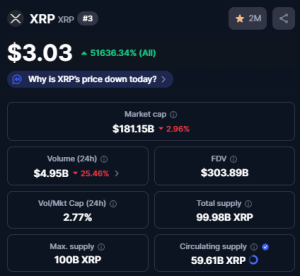
This number helps you compare XRP to giants like Bitcoin without overcomplicating things. It’s not the full story, though; it only counts the number of tokens available and actively floating around for trading in the market.
Supplies are where things get interesting; they’re like the difference between what’s in your wallet, what’s in the bank vault, and the grand total you’ll ever have.
Here’s the lowdown for XRP:
| Type | Amount | What It Means |
|---|---|---|
| Circulating Supply | 59.61 Billion | Tokens out in the wild, ready for buys and sells. This drives the market cap. |
| Total Supply | 99.99 Billion | Every token created so far, including locked-up or escrowed chunks (like Ripple’s reserves). |
| Max Supply | 100 Billion | The hard cap; no more XRP will ever be minted. It’s fixed forever. |
See the ties? Market cap uses circulating supply because that’s the “real” liquidity right now.
If more tokens trickle out from total to circulating (say, from escrow releases), it could dilute things a bit if demand doesn’t keep up. But XRP’s max supply being capped at 100 billion keeps inflation in check, unlike some coins that print endlessly.
Understanding this stuff turns crypto from a guessing game into something you can wrap your head around. XRP’s setup shines for fast payments (think cross-border wires), and its supplies give a peek at future vibes. If circulating supply creeps toward that 100 billion max without price pumps, watch for shifts.