

I posted this image on Threads, and it started an argument.. It hits hard: USD = Your money ÷ ∞ (endless printing eroding value), while BTC = Your money ÷ 21M (scarcity fueling growth).
As of September 16, 2025, with BTC trading around $115,600 and a market cap of $2.3 trillion. Let’s unpack the mechanics, history, comparisons, and why no altcoin stacks up.
Bitcoin divided by 21 million screams scarcity.
Fixed supply means rising demand pushes prices up. Those upward arrows? A nod to long-term holders (HODLers) watching value compound. It’s not just a meme; it’s monetary rebellion against dilution.
Scarcity by Design; Bitcoin isn’t just deflationary, it’s engineered that way. Satoshi Nakamoto capped supply at 21 million to mimic gold’s rarity, preventing inflation. New BTC enters via mining: Miners solve puzzles to validate blocks, earning rewards. But halvings every 210,000 blocks (~4 years) slash rewards in half, slowing issuance.
Once all 21M are mined (around 2140), no more new BTC forever. Lost coins (estimated 3-4M from forgotten wallets) make effective supply even tighter, under 18M usable.
Demand from institutions (ETFs hold 1M+ BTC) and nations (El Salvador’s reserves) creates upward pressure. Unlike inflationary assets, BTC’s value rises as adoption grows, rewarding savers over spenders.
Deflation incentivizes holding (velocity drops), stabilizing as a store of value. Critics say it discourages spending, but in a digital gold role, that’s the point, it’s not for coffee runs.
Halvings are Bitcoin’s heartbeat, reducing supply influx and often sparking bull runs. Here’s the timeline:
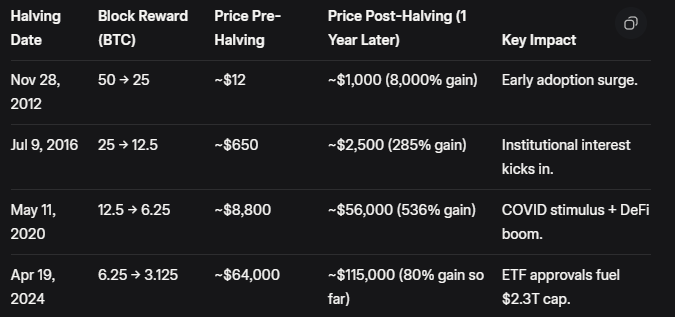
Next up: March 26, 2028, reward to 1.5625 BTC/block. Post-2024, issuance is ~0.8% annually—lower than gold’s 1-2%. History shows halvings correlate with 300-500% gains in 12-18 months, as miners sell less and scarcity bites.
Bitcoin’s uniqueness? It’s the only crypto with true monetary policy baked in—decentralized, predictable, immutable. Alts chase features but fumble scarcity. Let’s compare supplies:
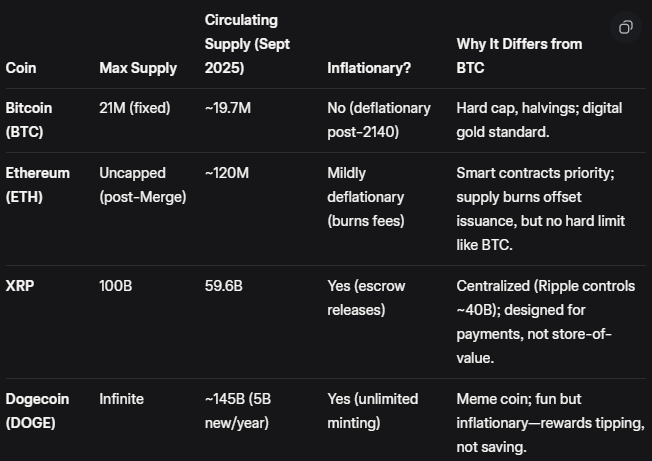
ETH’s “ultrasound money” vibe (net deflation since 2022) is cool, but its uncapped potential and upgrades (e.g., Dencun) add uncertainty. XRP’s pre-mined billions enable fast transfers but invite dumps. DOGE? Endless supply = endless jokes, no scarcity.
BTC’s $2.3T cap (55% market dominance) towers over ETH’s $530B, XRP’s $180B, and DOGE’s $40B—proving network effects and trust win.
What sets BTC apart further:
Alts innovate (ETH’s DeFi, XRP’s remittances), but none match BTC’s purity as sound money.
Bitcoin’s not flawless. Volatility (30-50% drawdowns) scares normies. Regulatory hurdles (e.g., SEC vs. miners) loom. And if quantum computing cracks SHA-256? Upgrades like Taproot help, but it’s a risk. Still, deflationary traits shine in hyperinflation zones (Venezuela, Argentina) where BTC preserves wealth.
That image? A blueprint for the future. With global debt exploding and fiat trust eroding, BTC’s 21M cap is a hedge against chaos. Projections? Analysts eye $200K+ by 2026 post-halving echo. Bottom line: In a world of infinite money, finite beats it every time.