

On Friday 10th October, the crypto market experienced its own Black Friday. In a matter of hours, over $19 billion was wiped from existence from the crypto futures market. More than 1.6 million traders were liquidated, and it was all triggered by a single post on social media. This was the largest liquidation event in crypto history, and it has left many asking the same question.
Is the bull market over? Is it over?
I’ll break down the minute-by-minute timeline of the crash and explain why it was so devastating.
Early last week, the market was euphoric. It was. Bitcoin had just printed fresh, all-time highs above $126,000 and sentiment was overwhelmingly bullish. By Friday morning, BTC was still trading comfortably above $122,000.5
But behind the scenes, the geopolitical tectonic plates were shifting. On Thursday 9 October, China announced new export controls on rare earth minerals, a critical component in everything from iPhones to F35 fighter jets. This was a strategic power play by Beijing, and it did not go unnoticed.
On Friday morning, Donald Trump fired his first warning shot on Truth Social, threatening a massive increase in tariffs on Chinese goods. This initial threat was enough to rattle the markets with Wall Street’s fear gage, the Vix soaring 32%.
And Bitcoin began to bleed, dipping from the $122,000 level to around $117,000. But that was just the appetizer. The main course arrived later that afternoon. In a second decisive post, Trump declared that the United States would impose a 100% tariff on all Chinese imports, “Over and above any tariff that they are currently paying”. Trump hit the send button, and the floor fell out of the crypto market.
Bitcoin fell $3,000 almost instantaneously. But that was just the beginning of a historic liquidation cascade. Within 14 minutes, BTC flash crashed to lows of $102,000 on some exchanges like Binance.
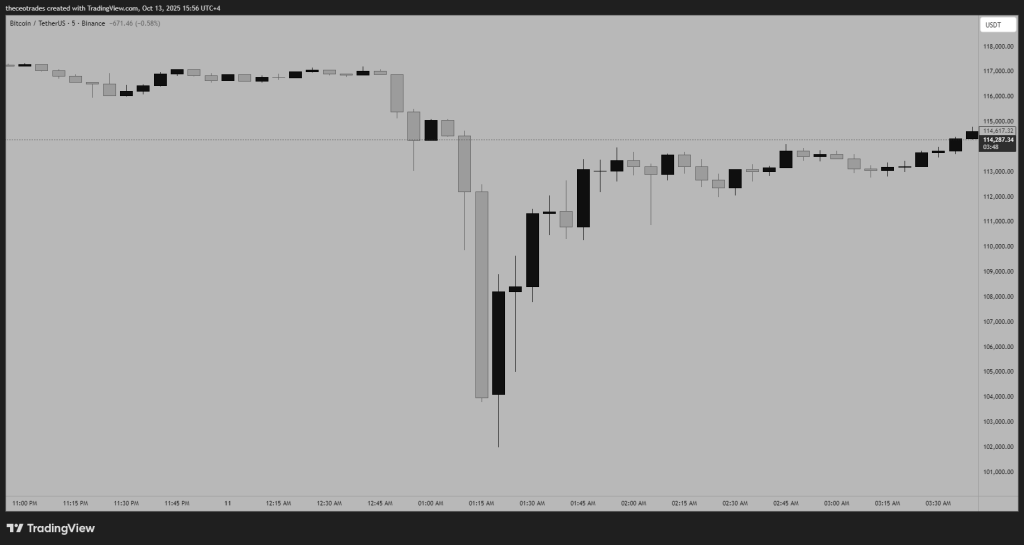
In a matter of 7 hours, the world’s biggest cryptocurrency had dropped by $20,000. Altcoins, meanwhile, were absolutely eviscerated.
Within 10 minutes, here’s what happened:
Others dipped over 90% and some fell to ZERO.
So then why was this crash so incredibly severe? Well, it was the perfect storm of extreme leverage, very poor timing and failing infrastructure.
For weeks, leverage had been building up to precarious levels. Just before the crash, Bitcoin open interest had surged to a record high of over $94 billion. The announcement also hit on a Friday afternoon, a period of notoriously low liquidity when traditional markets are closing. This created a domino effect.
As the price fell, leveraged long positions were automatically sold by exchanges. These massive sell orders pushed the price down, further triggering even more liquidations in a vicious downward spiral.
In total, a staggering $19.1 billion in leveraged positions was wiped out in just 24 hours. Now to put that into some perspective, the infamous Covid crash of March 2020 saw just $1.2 billion in liquidation. The FTX collapse triggered around $1.6 billion.
So, this event was nearly 20X larger than the COVID panic and it impacted over 1.6 million individual traders. The carnage was amplified by the very exchanges meant to provide stability. High profile traders reported that major platforms like Binance, Coinbase and Robinhood experienced technical issues with order books freezing and stop loss functions being disabled at the most critical moments.
So, this technical failure turned a sharp correction into an all-out market collapse. Now, while Trump’s post was the trigger, he claimed the move came, “out of the blue”. But I believe it was all planned.
It’s a high stakes game of geopolitical brinksmanship and the crypto market just got caught in the crossfire. But the sheer perfection of the timing of this crash has led many to suspect something more sinister than just a geopolitical spat.
So, was there insider trading? Well, the evidence is compelling. On the derivatives exchange Hyper liquid one Whale Wallet executed a series of perfectly timed trades that netted them a reported profit of nearly $200 million.
Blockchain analysis shows this trader, identified as a Bitcoin OG who has held coins since 2011, began building massive short positions against BTC and ETH just days before the crash. Then they doubled down on these shorts just 30 minutes before Trump’s tariff announcement.
This uncanny timing has led to rampant speculation. Was this simply a savvy macro trader reading the charts? Or did someone get an early whisper of Trump’s plan?
Prominent crypto attorneys are already calling for a full investigation and hey, who can blame them? So, with the market in turmoil, the multi-billion-dollar question, where do we go from here? Can bitcoin and altcoins recover? Well, let’s start with the good news. Despite the chaos, Bitcoin held the critical $100,000 support zone.
After a brief dip below $102,000, it quickly bounced back and has since stabilized in the $110,000 to $113,000 range. So, this tells us that the crash was primarily a derivative led leverage flush, not a fundamental breakdown in spot market conviction.
In fact, on chain data shows that institutions saw this as a massive buying opportunity. BlackRock’s Spot ETF reportedly scooped up over 21,000 BTC mid chaos and XRP whales added over a billion tokens to their bags during the dip. This suggests that smart money believes the long-term bull run is still very much alive.
The fundamentals have not changed, only sentiment and leverage have. This event has brutally reset the market, clearing out excessive greed and creating a much healthier foundation for a sustainable climb.
The altcoin season index has fallen to 35, well below the 75 point threshold. That signals a true alt season.
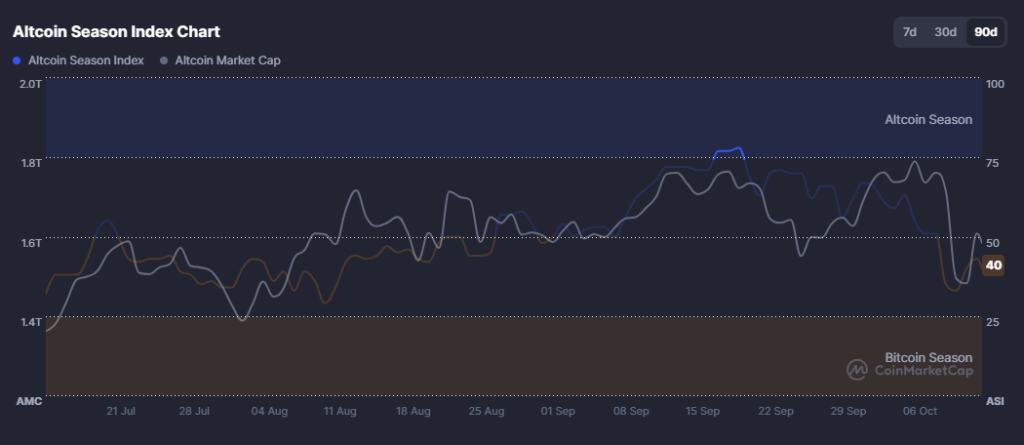
Bitcoin dominance has spiked as capital has fled to the relative safety of the king this doesn’t mean altcoins can’t recover, but it does suggest that the days of everything pumps are likely behind us.
The next alt run will probably be much more selective, driven by specific narratives like for instance, AI, real world assets or upcoming spot ETF approvals for tokens like Solana and XRP. And this brings us to the single biggest variable that will dictate the market’s direction for the rest of the year and beyond.
I’m not a financial advisor and nothing in this blog should be considered financial advice. This is educational content meant to inform you about the recent crypto market crash and its potential implications.
Trade at your own risk.